

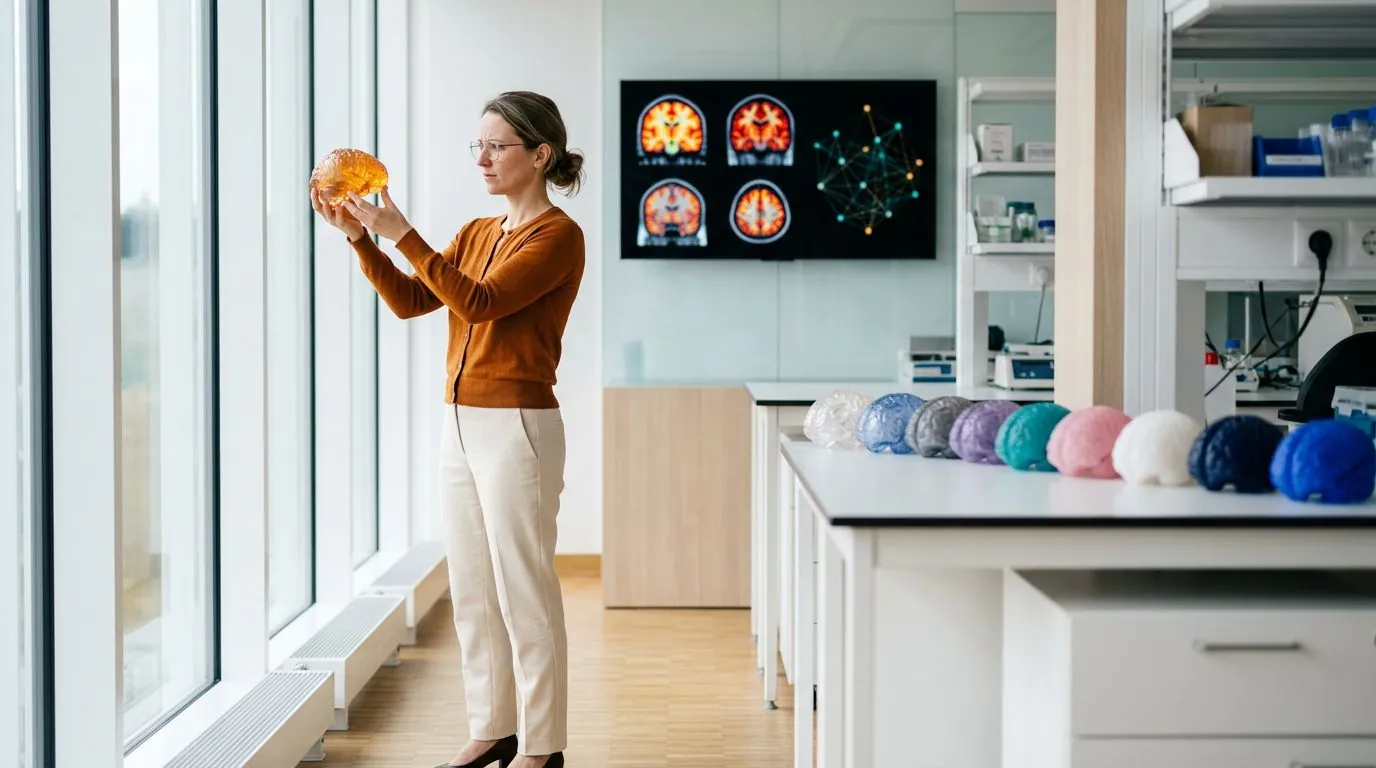

Shahar Arzy’s team at the Hebrew University of Jerusalem has published a review in the journal Brain proposing a Bayesian “metamodel” of Alzheimer’s disease. Instead of one model meant to explain every patient, it would be a network of linked partial models that build an individual profile of each patient. The authors examined nine successive definitions of the disease from 1908 to 2024 and concluded that none captures its full diversity, because two people with the same diagnosis can have entirely different combinations of biological and cognitive changes.
- Shahar Arzy's team at the Hebrew University of Jerusalem published a review in the journal Brain proposing a Bayesian "metamodel" of Alzheimer's disease, a network of linked partial models that would build an individual profile of each patient.
- The authors examined nine successive definitions of Alzheimer's disease from 1908 to 2024 and concluded that none captures its full diversity, because two people with the same diagnosis can have entirely different combinations of biological and cognitive changes.
- The paper is a proposed research program, not a finished diagnostic tool: no working metamodel has been built or validated on patients, and the only implementation so far is AD_Metamodeling, a student prototype on GitHub that combines the existing AD-ODE and SuStaIn models.
The paper, “Alzheimer’s disease in the computational era: from a deterministic disease to a multifaceted disorder,” appeared online on July 30, 2026. The final, revised version was published on October 16, 2026. The authors are Meitar Benbaji, Barak Raveh, Lana Bassal, Uri Elias, Lidor Gazit, Gilles Allali, Gad A. Marshall and Shahar Arzy. Besides the Hebrew University and Hadassah Medical Center, the team includes researchers from University Hospital of Lausanne and Harvard Medical School.
The paper is a proposed research program, not a finished diagnostic tool. No one has yet built a working metamodel, validated it on patients or shown that it improves prognosis.
Nine definitions in 118 years and still no agreement on what Alzheimer’s is
The first part of the review shows that the definition of Alzheimer’s disease has changed nine times since 1908, swinging between a clinical and a biological description. The authors walk the reader from Alois Alzheimer’s first patient, Auguste Deter, through the 1984 NINCDS-ADRDA criteria, the amyloid cascade hypothesis of the 1990s and the 2018 AT(N) system. They end with the 2024 Alzheimer’s Association criteria, which treat the disease as a biological entity defined by biomarkers, even when no symptoms are present.
The International Working Group has criticized that latest definition. It holds that people with a positive biomarker result but no symptoms should not be labeled as having Alzheimer’s. The dispute is not academic: it determines who gets a diagnosis, who enters a clinical trial and who receives a drug.
The authors conclude that the disease cannot be described by a single process, whether amyloid, tau, lipid metabolism or inflammation. Each successive definition emphasized one aspect and obscured others.
The authors describe Alzheimer’s as a disorder on four linked levels
Instead of one definition, the researchers propose describing the disease on four connected levels, each internally diverse:
- Cognitive-behavioral level: not only memory but also orientation, language, visuospatial function and neuropsychiatric symptoms such as apathy, depression or delusions, which can appear before dementia.
- Biological-pathological level: besides amyloid and tau, also inflammatory, vascular and metabolic processes, infections, environmental toxins and co-occurring pathologies such as TDP-43 or alpha-synuclein.
- Neuroanatomical level: at least four subtypes of tau spread through the brain, each matching a different clinical picture.
- Genetic level: from APOE variants to polygenic risk scores covering thousands of alleles.
The review cites an analysis of 14,571 Montreal Cognitive Assessment tests, which found that orientation and memory are the most impaired functions in Alzheimer’s patients, followed by attention and visuospatial processing. It separately describes a study of 889 postmortem brains that identified atypical subtypes of the disease: hippocampal-sparing and limbic.

The metamodel links specialized models through shared hidden variables
Metamodeling follows a “divide and conquer” strategy. Smaller, specialized models of individual aspects of the disease are built first, then combined into one probabilistic structure. Each partial model is converted into a so-called probabilistic surrogate, a probability distribution describing the relationships among its inputs, outputs and parameters. A coupling layer then joins the surrogates through shared hidden variables such as disease stage, subtype, rate of progression or pathology burden in a given brain region.
The authors list eight classes of partial models that could feed the metamodel. They range from models mapping MRI and PET images to symptoms, through models forecasting a patient’s trajectory over 1-3 years and biomarker cascade models, to cellular-state models based on single-cell sequencing and genetic risk models. Interventions, such as anti-tau therapy, would be represented as a change in a parameter value, for example a slower rate of tau spread.
One feature is unusual. Several competing models can coexist in the same category, for example different published models of amyloid and tau spread. The data weigh them against each other in a single probabilistic space. In a field that has argued for decades over which mechanism matters most, that is an argument for the approach, not just a technical detail.
Arzy, quoted in a university press release, states the goal plainly: “we need to understand the individual profile of the disease”.
Analysis
The metamodel sounds appealing because it promises to reconcile every school of thought on Alzheimer’s instead of picking one. But the mechanism that lets it combine knowledge also lets it combine errors. If the amyloid cascade model is poorly calibrated and the tau model rests on data from a few hundred people, coupling them into one structure will not fix either. It will produce a more complex and harder-to-challenge mistake. The authors acknowledge this themselves and write about years of work and the effort of the whole research community.
What interests me more is something else. This paper is evidence that medicine is starting to treat AI not as an image classifier but as a language for organizing contradictory hypotheses. I find that a more mature approach than yet another model that detects disease from a scan with 95% accuracy. The open question is whether anyone will fund something that cannot be sold as a product within two years.
The first implementation is a student prototype
A repository called AD_Metamodeling is available on GitHub. It is a project by Hebrew University student Amit Meiri, supervised by Shahar Arzy and Barak Raveh. It combines two existing, independent models: AD-ODE, which describes the temporal dynamics of biomarkers and clinical stages, and SuStaIn, which models spatial patterns of tau accumulation in the brain. The repository is prototype scale, not a clinical tool.
Other groups are working in parallel on personalized progression models. In 2026, PLOS Computational Biology published a paper by Chunyan Li and co-authors. Using data from 1,891 participants in the Alzheimer’s Disease Neuroimaging Initiative, they built a graphical dynamic model that predicts the joint evolution of amyloid, tau, neurodegeneration and cognitive function. The difference from the Jerusalem proposal is that theirs is a single model, not a structure joining many models from different authors.
The review’s authors themselves note that most available research databases cover at most a few thousand participants and focus on a few data types. A dataset of that size is not enough to train a metamodel spanning the four levels of the disease. They expect the whole effort to take time, and say it “might require years to bear fruit”.
The work was funded by BIRAX Ageing, Alzheimer’s Research UK, Race Against Dementia and Rosetrees, among others. One small detail from the acknowledgments: some of the icons in the figures were generated with the Nano Banana model (Gemini 2.5 Flash Image).
What the approach needs: large datasets, and a payoff with cheaper data
A metamodel needs large, multimodal datasets: PET and MRI imaging, blood and cerebrospinal fluid biomarkers, genetic data and long-term cognitive assessments.
If the approach proves out, countries with large undiagnosed populations could benefit most from tools that predict the course of the disease from cheaper data, such as digital tests or blood biomarkers, without the need for PET scans.
Sources and methodology
- Benbaji et al., Brain, Oxford University Press: published online July 30, 2026, revised version October 16, 2026.
- Medical Xpress: coverage of the Hebrew University press release, via Medical Xpress.
- Unite.AI: October 18, 2026.
- AD_Metamodeling on GitHub: implementation details.
The quotes from Shahar Arzy and the excerpt from the Brain paper were checked against the original English source material.
Analysis and editorial responsibility: Piotr Wolniewicz, Editor-in-Chief, AIPORT. Original Polish reporting: Natalia Kaszubowska (aiport.pl).
This article was originally published in Polish on aiport.pl on October 20, 2026.
https://aiport.pl/co-nowego-w-ai/uniwersytet-hebrajski-proponuje-model-modeli-choroby-alzheimera-jedna-diagnoza-ma-skrywac-wiele-roznych-chorob/