

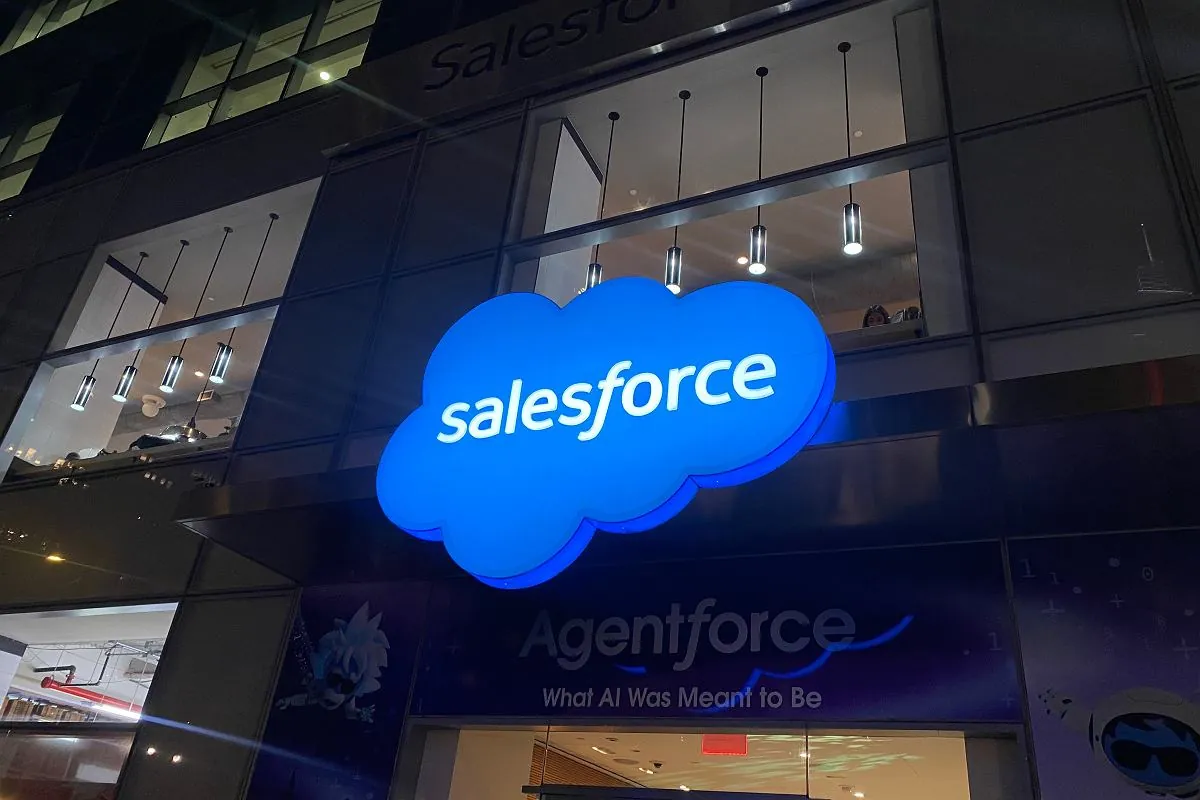
Salesforce says its AI agents generated more than $88 million in revenue by contacting prospects the company had never reached out to before. According to Itai Margalit, the Salesforce vice president responsible for sales in Israel, about 75% of the company’s 100 million leads went unanswered before the agents were deployed.
- Salesforce says its Agentforce AI agents generated more than $88 million in revenue by contacting leads the company had never reached before, according to Itai Margalit, Salesforce's vice president for sales in Israel, speaking at the Israel Information Technology Conference 2026.
- About 75% of Salesforce's 100 million leads went unanswered before the agents were deployed, because roughly 400 sales development representatives could not cover the millions of leads arriving each year.
- CTech reports that Salesforce did not say what period the $88 million covers or how much is attributable directly to the agents rather than to salespeople who took over conversations, while the company's October 2025 pilot results listed 800 booked meetings and "dozens" of closed deals with no dollar figure.
Margalit spoke at the Israel Information Technology Conference 2026 in Tel Aviv. His talk was covered by CTech, a news site owned by the Israeli business daily Calcalist, in an article published October 18, 2026. Salesforce, the maker of the widely used CRM software, described the project a year earlier in a company blog post dated October 9, 2025. The numbers it gave then were far more modest.
Three-quarters of Salesforce’s 100 million leads went unanswered
The problem is not new. Marc Benioff, Salesforce’s CEO, estimated that over the past 25 years about 100 million sales leads went unanswered because the company did not have enough people to call back. Historically, only one in four leads was worked. The rest scored too low in the lead-scoring system to justify contact from a human.
The mismatch is easy to size. Salesforce employs about 400 sales development representatives (SDRs, the people who make first contact with a potential customer), while millions of leads reach the company each year. According to Vanessa Tabbert, Senior Director of Sales Development at Salesforce, tens of thousands of people fill out forms on the company’s website every day.
Tabbert said: “We could never scale enough humans to do that level of outreach.”
Margalit put it more briefly in Tel Aviv: “Today, thanks to AI agents, no lead is left behind.”
The agent writes the first email, a human takes over when interest appears
Salesforce began using its own Agentforce platform to handle leads in July 2025. The mechanism described on the company blog works like this:
- The agent gets its own account and permissions in the CRM, and its actions appear in each lead’s activity history.
- Using data from a form, webinar or event, it generates a personalized first email.
- If the recipient does not respond, the agent sends a follow-up.
- If the recipient replies, the agent gauges the level of interest, sends a link to book a meeting and copies a salesperson on the thread.
- It answers product questions based on documentation uploaded to a tool called Agent Builder.
- Every email stated from the start that the sender was Agentforce, not a human.
Salesforce published results as of October 1, 2025, less than three months into the pilot. They were concrete but modest: 68,000 leads re-analyzed and reactivated, 156,000 emails sent, 94,000 opens, 2,400 replies, 800 automatically booked meetings and “dozens” of closed deals.
Jenny Tran, a senior director of product management for sales and AI agents, acknowledged at the time that the default email templates were too generic. The real work, she said, was tuning prompts and choosing the content the agent should convey. Tabbert also announced a new hybrid role: an SDR paired with an agent would handle 15,000 leads a month instead of 500.

$88 million is a number without a methodology
The headline figure from Tel Aviv has no confirmation beyond Margalit’s word. CTech states plainly that Salesforce did not say what period the $88 million covers, or how much of it can be attributed directly to the agents rather than to the salespeople who took over the conversations.
The talk contained a second figure. According to Margalit, handling a comparable number of first contacts by conventional means would take about 400 additional employees. That is exactly the number of SDRs Salesforce has today. It is not clear whether that is a coincidence or a simplified calculation that amounts to doubling the team.
Setting Salesforce’s two publications side by side shows how carefully revenue claims about AI have to be read:
- October 2025, company blog: 800 meetings, “dozens” of deals, no dollar amount.
- October 2026, Tel Aviv conference: more than $88 million in revenue, no period and no methodology.
A year passed between the two announcements, which probably explains much of the difference in scale. But the jump from “dozens” of deals to $88 million is also a jump from operational numbers that can be checked to a marketing number that cannot, at least for now. That is my interpretation, not the company’s position.
Analysis
I have worked in B2B lead generation for years, and I have no doubt the problem Salesforce describes is real. A lead nobody has contacted for two days is usually already talking to a competitor. An automated first touch within minutes is a genuine advantage. Believing in AI is not required to see that; arithmetic is enough.
But $88 million is a number announced at a sales conference by the company that sells Agentforce, with no period, no methodology and no indication of how much of it a human produced after taking over the conversation. A year earlier the same company wrote about “dozens” of deals. I’ll believe the $88 million when I see how it was counted.
Second, Margalit is honest about one thing: this did not work out of the box. Salesforce had its own customer data in its CRM, its own platform and 400 SDRs to teach the agent, and it still had to rewrite prompts and invest in cleaning up data. The average company that buys Agentforce has none of those advantages. The question, then, is not whether an agent can send an email. It is whether your customer data is good enough for anyone to write anything based on it.
Margalit says AI can’t simply be layered onto old processes
The second theme of the Tel Aviv talk was why AI projects fail inside companies. According to Margalit, many start at the wrong end: from the desired outcome rather than from a defined problem. His advice is to start with small deployments and pick use cases that combine high business value with simplicity of launch.
Margalit also argued that an organization cannot leave its business processes unchanged and just add AI on top. The way people work has to change. As an example, he cited running agents directly inside Slack, without switching to a separate application.
A data foundation is the condition that recurs in both Salesforce communications. Margalit spoke of a single source of truth about customers, employees and company activity, shared by humans and agents. A year earlier, Tran had said the same thing in practical terms: all the content the agent uses comes from the CRM and Data 360 (formerly Data Cloud, Salesforce’s tool for unifying data from different systems). Without reliable data, CTech notes, automation replicates errors or works from an incomplete picture of the company.
Agentforce ARR passed $1.5 billion, but the figure is not like-for-like
The $88 million story is part of a larger Salesforce sales narrative. The company reports Agentforce as its main growth engine and publishes new numbers every quarter.
In results for the second quarter of fiscal 2027 (ended July 31, 2026, reported August 26, 2026), Salesforce said Agentforce annual recurring revenue (ARR) exceeded $1.5 billion, up more than 240% year over year. Combined ARR for Agentforce and Data 360 reached nearly $3.9 billion. For comparison, Agentforce ARR was $800 million at the end of fiscal 2026 (January 31, 2026) and about $540 million in the third quarter of fiscal 2026.
Caution is needed here too. Salesforce noted that starting in the second quarter of fiscal 2027, Agentforce ARR also includes other AI offerings, among them Slackbot and Headless 360, so the $1.5 billion is not fully comparable with earlier quarters. Salesforce’s total quarterly revenue was $11.3 billion, and the company raised its fiscal 2027 guidance to $46.1-$46.4 billion.
What to check before trying this
For any company considering this model, the most useful takeaway is not the $88 million but the list of conditions Salesforce had to meet internally:
- Customer data organized in one place.
- Its own refined prompts.
- Emails openly labeled as sent by an agent.
- A salesperson who takes over the conversation when interest appears.
Conference presentations usually leave these costs out.
Sources and methodology
- Salesforce blog, “100 Million Missed Opportunities Later, We Found a Better Way To Sell”, October 9, 2025.
- Salesforce, second quarter fiscal 2027 results, August 26, 2026.
- CTech (Calcalist), report from the Israel Information Technology Conference 2026, October 18, 2026.
Quotes from Itai Margalit (Area Vice President, Sales, Israel, Salesforce) and Vanessa Tabbert (Senior Director of Sales Development, Salesforce) were verified against the original English-language source material.
Analysis and editorial responsibility: Piotr Wolniewicz, Editor-in-Chief, AIPORT. Original Polish reporting: Natalia Woś (aiport.pl).
This article was originally published in Polish on aiport.pl on October 19, 2026: https://aiport.pl/co-nowego-w-ai/salesforce-twierdzi-ze-agenci-ai-przyniesli-88-mln-dolarow-z-leadow-ktorych-wczesniej-nikt-nie-obslugiwal/