

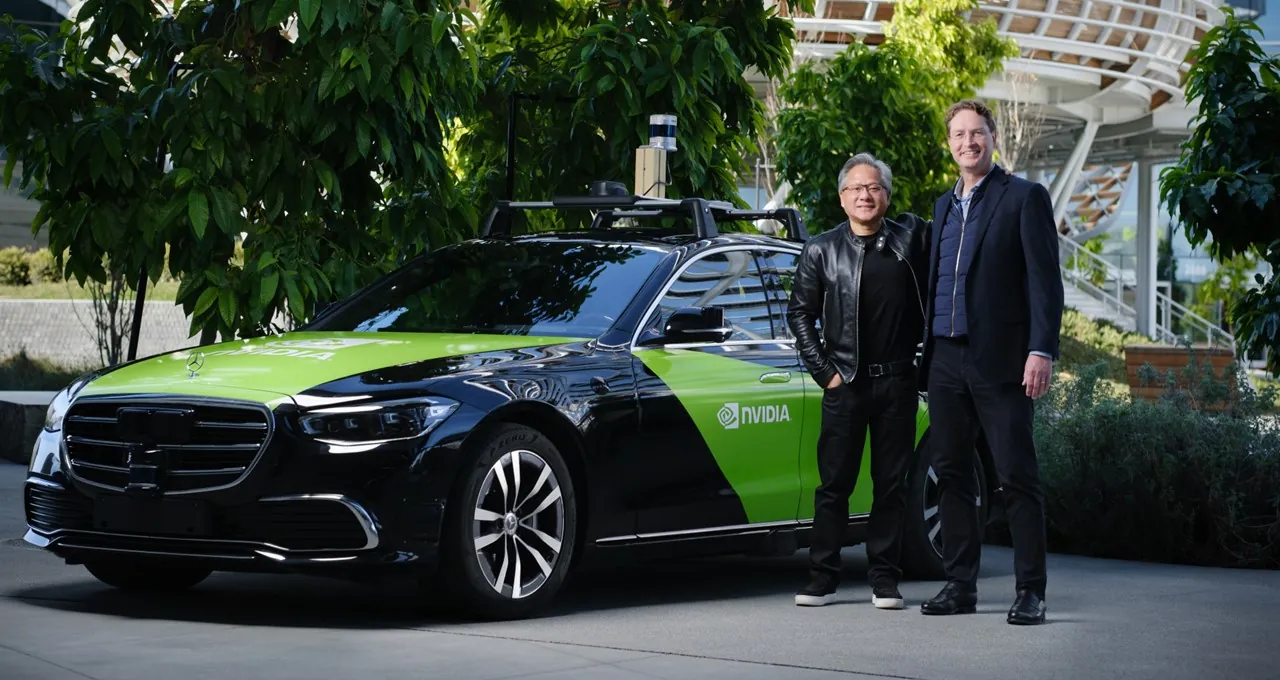
Mercedes-Benz and NVIDIA announced an expanded strategic partnership on October 16, 2026, aimed at a new generation of driver-assistance and autonomous systems, including so-called Level 4 robo-limousines under the SAE classification. Future Mercedes cars are to pair the company’s MB.OS operating system with three layers of NVIDIA technology: the Hyperion compute-and-sensor architecture, the Alpamayo Stack software and the Halos safety system.
- Mercedes-Benz and NVIDIA announced an expanded partnership on October 16, 2026, under which future Mercedes cars will pair the MB.OS operating system with NVIDIA's Hyperion architecture, Alpamayo Stack software and Halos safety system, aimed at advanced driver assistance and future Level 4 robo-limousines.
- The companies gave no timeline, no models that will get the technology first and no financial terms, saying only that the partnership targets safe, highly automated driving in the next decade.
- Mercedes already sells Level 3 Drive Pilot in the S-Class and EQS, which allows hands-off, eyes-off highway driving at up to 95 km/h in Germany, and the NVIDIA-co-developed Level 2 MB.DRIVE ASSIST PRO debuted in China in the electric CLA in late 2025.
The companies gave no timeline for the new features, no models that will get them first and no financial terms. The announcement, published in parallel from Stuttgart and Santa Clara, speaks of safe, highly automated driving in the next decade.
NVIDIA supplies the hardware, software and safety layer, while Mercedes brings MB.OS
The split of roles is clear. Mercedes-Benz contributes engineering experience, safety expertise and its own operating system, MB.OS. NVIDIA supplies nearly the entire technology stack responsible for automating the drive.
According to the announcement, that stack consists of:
- NVIDIA Hyperion, the onboard compute architecture and sensor suite (called NVIDIA DRIVE Hyperion until September 2026),
- NVIDIA Alpamayo Stack, complete driving software with AI-based reasoning, covering point-to-point urban driving, active safety systems and automated parking,
- NVIDIA Halos, a safety system with a parallel protective layer meant to add redundancy and reduce the risk of unwanted software behavior.
In this setup MB.OS handles the new driving functions and online updates. The companies say the combination is meant to support both advanced assistance systems and future Level 4 uses, including robo-limousines.
Jörg Burzer, the Mercedes-Benz Group AG board member responsible for technology development and procurement, left no doubt about the weight of the relationship:
“NVIDIA is our most important strategic partner in automated driving”
Burzer also noted that the two companies jointly developed Mercedes’ first driver-assistance system enabling point-to-point city driving in Western markets. Ali Kani, NVIDIA’s vice president for automotive, said that accelerated computing gives vehicles the intelligence to understand their surroundings and analyze complex road situations, and that the goal of the partnership is to make autonomous driving an everyday reality.

Level 4 means no human driver, but only under defined conditions
Level 4 robo-limousines are the most ambitious element of the announcement, though the release describes them as a future application, not a finished product.
Under the SAE classification (Society of Automotive Engineers, the body that sets automotive standards), Level 4 means the car performs the entire driving task on its own, with no need for a human to take over, but only within a defined area or set of operating conditions. That differs sharply from Level 2, where the driver must supervise at all times, and Level 3, where the driver may look away from the road but must be ready to take control when the system asks.
Mercedes sells both lower levels today. Drive Pilot is a certified Level 3 system available in the S-Class and EQS. In Germany it allows highway driving with hands off the wheel and eyes off the road at speeds up to 95 km/h. MB.DRIVE ASSIST PRO, a Level 2 system developed with NVIDIA, debuted in China in the electric CLA in late 2025 and was shown at CES 2026 in Las Vegas. It handles traffic lights, lane changes, intersections and pedestrians in dense city traffic.
The October 16 announcement is also not the first sign that Mercedes is aiming at Level 4. On January 29, 2026, the company presented a plan for a robotaxi ecosystem based on the new S-Class, involving NVIDIA and Uber, along with a separate Level 4 project with the Chinese company Momenta. The first test robotaxis based on the S-Class were due on the roads of Abu Dhabi in 2026. The expanded NVIDIA partnership therefore appears to organize and extend work already underway.
Analysis
I read this announcement with mixed feelings. On one hand, Mercedes has been consistent. Since 2020 it has been building a software-defined car architecture with NVIDIA, it has a working Level 3 system, and it was the first Western manufacturer to show hands-off, point-to-point urban driving. This is not a company that throws out slogans with nothing behind them.
On the other hand, the announcement contains exactly zero specifics: no dates, models, markets or amounts. The timeframe, the next decade, is very elastic. In the same week Volvo Cars published a nearly identical announcement about Hyperion, Alpamayo and Halos, and Hyundai and Kia have spoken in a similar tone before. I’m starting to think this is more NVIDIA’s strategy than Mercedes’: supply carmakers the whole stack, from sensors to the safety layer, and leave them only the brand and the validation.
The question I consider most important follows from that. If Mercedes, Volvo and Hyundai all run on the same NVIDIA software, what will set them apart beyond the price of the leather seats? Mercedes spent decades building its advantage on its own engineering. Handing the car’s brain to an outside supplier may make economic sense, but strategically it is a bet that a premium brand’s edge survives the moment when driving stops being a skill and becomes a service.
Volvo, Hyundai and Kia are betting on the same NVIDIA stack
Mercedes is not the only manufacturer to deepen its NVIDIA ties in October 2026, which shows how far the Santa Clara company wants to extend its reach over autonomous-vehicle software.
On October 15, 2026, the day before the Mercedes announcement, Volvo Cars announced an expansion of its partnership with NVIDIA, which dates to 2017. The Swedish automaker will also use the Hyperion architecture, the Halos OS system and the Alpamayo Stack software. The technology is to debut in a next-generation model that Volvo has not yet named, with a gradual rollout of driving that does not require the driver to watch the road or think about it. According to TechCrunch, Volvo also plans to standardize its sensor suite on Hyperion, which means even deeper dependence on a single supplier.
NVIDIA said in March 2026 that its Alpamayo models had been downloaded by more than 100,000 automotive developers worldwide. The Alpamayo 1.5 model takes driving video, the vehicle’s motion history, navigation cues and natural-language commands as input, and outputs a trajectory along with a reasoning trace.
For Mercedes, the NVIDIA relationship extends beyond autonomous driving. The carmaker also uses NVIDIA technology in engineering simulations and in its MO360 digital production ecosystem, from virtual process planning to AI applications in factories. According to the announcement, the two companies want to keep improving efficiency, flexibility and quality across Mercedes’ global network of about 30 plants.
Drive Pilot is limited to select markets, and urban assist is reportedly due in Germany by early 2027
Mercedes offers Level 3 Drive Pilot today only in select markets, primarily Germany and some US states. According to CBT News, the urban MB.DRIVE ASSIST PRO is expected to reach Stuttgart and Munich by the end of 2026 and appear across Germany in early 2027.
Sources and methodology
- NVIDIA and Mercedes-Benz joint press release, October 16, 2026
- Mercedes-Benz Group page on its robotaxi ecosystem, January 29, 2026
- Volvo Cars press release, October 15, 2026
- TechCrunch, on Volvo’s plan to standardize its sensor suite on Hyperion
- CBT News, on the rollout timing of MB.DRIVE ASSIST PRO
- Unite.AI
The quote from Jörg Burzer, member of the Board of Management of Mercedes-Benz Group AG, was verified against the original English-language source material.
Analysis and editorial responsibility: Piotr Wolniewicz, Editor-in-Chief, AIPORT. Original Polish reporting: Natalia Kaszubowska (aiport.pl).
This article was originally published in Polish on aiport.pl on October 19, 2026.
https://aiport.pl/co-nowego-w-ai/mercedes-benz-i-nvidia-rozszerzaja-partnerstwo-celem-sa-limuzyny-poziomu-4-jezdzace-bez-kierowcy/