

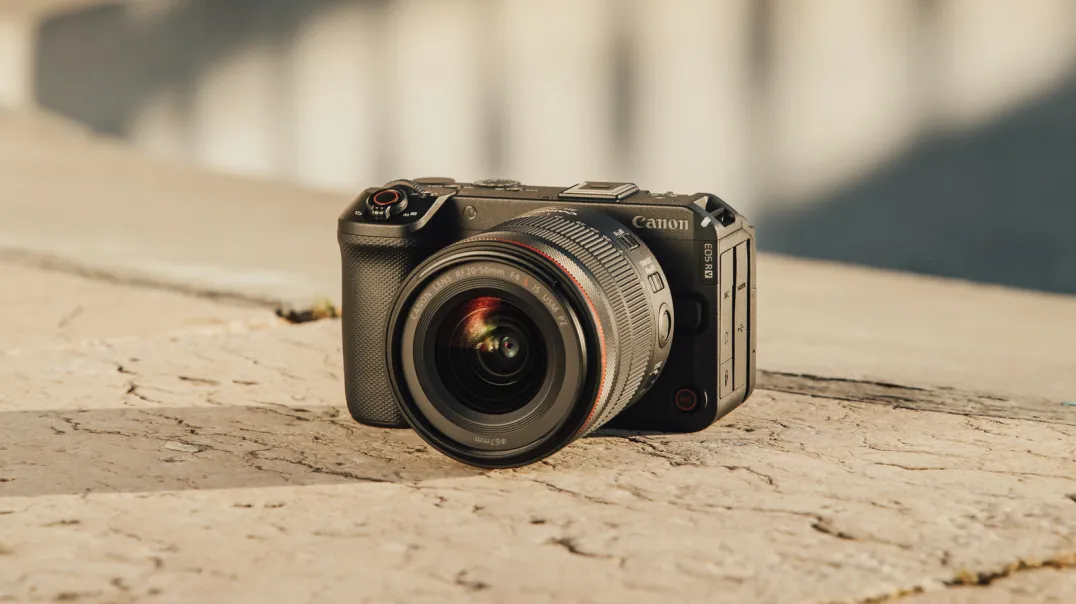
Canon, the Japanese camera maker, has filed U.S. patent application US 2026/0278802 A1, published September 17, 2026, describing a camera with two sensors that capture the same scene at the same moment. Data from the second sensor would feed a cryptographic record of the photo’s history under the C2PA standard and, as a side benefit, allow a small focus correction after the shot.
- Canon filed U.S. patent application US 2026/0278802 A1, published September 17, 2026, describing a camera with two sensors that capture the same scene at the same moment, producing a reference image that feeds a C2PA cryptographic record of the photo's history.
- According to the filing as reported by Digital Camera World, the differences between the two sensors' images would also allow a small post-shot focus correction, and the authenticity certificate would stay intact if focus correction was the only change.
- On May 11, 2026, Canon announced the C2PA-compliant Authenticity Imaging System for media organizations, which works with the Canon EOS R1 and EOS R5 Mark II, requires a paid activation and was tested by Reuters before launch.
Canon’s approach is not an AI-image detector. Instead of hunting for traces of manipulation in a finished file, it documents from the first millisecond where a photo came from and what happened to it afterward.
Two sensors exposed at once create a reference image
The design in the patent uses two light-sensitive elements, which can be CCD or CMOS sensors, exposed at the same time. Both record the same scene, but the images differ slightly because they come from two somewhat different optical paths.
According to Digital Camera World, which obtained the text of the filing, recording two shots at once produces a reference image with parallax. The camera can use it to generate a certificate of authenticity. A later comparison with the main photo would show whether, and how much, the file has been altered.
The outlet points to a practical problem with today’s provenance certificates: most label a photo “modified” even after a minor exposure or color correction. A second image could help distinguish a cosmetic edit from heavy manipulation, because it captures not just that a change happened but its scale. That is Digital Camera World’s interpretation, not a claim by Canon.
The patent also mentions a field lens, a secondary coupling lens and zoom control. Digital Camera World says this suggests a camera with a built-in lens rather than a mirrorless body with interchangeable optics. The patent drawings do not show what a finished product would look like.
Provenance rests on C2PA, not on spotting AI
The patent refers to C2PA, the Coalition for Content Provenance and Authenticity, an open specification developed by a coalition of technology and media companies. C2PA lets a file carry a cryptographically signed manifest with information about the device that created the image and about later edits. The mechanism uses cryptographic hashes calculated from the file’s contents and digital signatures, so any change to protected data after authentication becomes detectable.
That design has a limit. A C2PA system can show that a photo was changed, but it does not necessarily show whether artificial intelligence made a given change. The standard confirms a file’s origin and integrity, not the truth of the scene it depicts.
A second limit concerns durability. A C2PA manifest can be removed on purpose, or lost when a file passes through software or a platform that does not support the standard. Missing data therefore does not prove manipulation. It means only that the file’s history cannot be confirmed. The C2PA coalition’s answer is Durable Content Credentials, which tie the manifest to an invisible watermark and a content fingerprint so a photo can be linked back to its provenance record even after the metadata is stripped.

The same mechanism can shift the focus plane after the shot
Differences between the two sensors’ images reveal the direction and size of a focus error. In later processing, the proportions in which the two images are blended can be changed, which shifts the focus plane within a limited range.
Digital Camera World writes that, according to the filing, the two sensors record the image at slightly different focus ranges, and the user can set that difference in the camera. The outlet adds that, per the patent, the authenticity certificate stays intact if a focus correction was the only change made.
The patent does not describe freely choosing after the fact which object is sharp. It describes a small correction within the recorded data. That could rescue a photo with a slightly missed autofocus, but it would not replace correct focus at the moment of shooting.
Canon has related experience. Dual Pixel RAW in the company’s current cameras uses two photodiodes in each pixel, placed in slightly different positions. That creates a small parallax and lets Digital Photo Professional software make micro-adjustments to focus. The new patent moves the idea from the pixel level to the level of the whole sensor.
Analysis
The most interesting thing about this patent is neither the second sensor nor the focus trick. It is the direction of thinking.
For the past two years, the industry has tried to win the race against image generators by building ever better detectors. I think that race is lost in advance, because every detector teaches the generators what to avoid. Canon and the rest of the C2PA coalition are doing the opposite. Instead of proving that something is fake, they want to prove that something is real. In the long run, it is the only strategy that makes sense.
It has one weakness, though, and people rarely talk about it. It works only if almost everything real is signed. As long as only Reuters reporters with professional cameras sign their work, a missing signature means nothing, because the photo from any ordinary phone is unsigned too. The question I care about is when this mechanism reaches mass-market smartphones, rather than another patent for a camera that may never be built. And who pays for activation, given that Canon already charges for it today?
Canon is already deploying an authenticity system for newsrooms, tested with Reuters
The patent filing is not an isolated idea. On May 11, 2026, Canon Inc. and Canon Europe announced the Authenticity Imaging System, a C2PA-compliant solution for media organizations. It supports photos from the Canon EOS R1 and Canon EOS R5 Mark II with the Image Authenticity function enabled. It is meant to preserve provenance information from the moment of capture through editing to publication.
Canon’s announcement contains several specifics:
- Canon joined C2PA and the Content Authenticity Initiative (CAI) in 2023.
- Reuters tested the system before its official launch and, according to Canon, confirmed that “authenticated provenance data could be generated reliably.”
- The C2PA function in the cameras requires a paid activation.
- Canon supplements the manifest created in the camera with public certificates and timestamps from trusted sources.
- According to Canon Europe, the rollout began in May 2026 in the EMEA region (Europe, the Middle East and Africa).
For comparison, Sony is testing C2PA-compatible workflows in professional video cameras, and Panasonic is taking part in developing the standard with hybrid photo-video systems in mind. Neither manufacturer has yet shown a camera that uses two sensors to produce a reference image.
A patent is not a product: Canon won 2,623 U.S. patents in one year
So far this is only a patent application. It is unknown whether the described design will reach a production camera. There is no model, release date or price.
The numbers show the scale of Canon’s patenting. According to a Canon release dated January 16, 2026, the company obtained 2,623 patents from the U.S. Patent and Trademark Office (USPTO) in 2025. That put it in seventh place in the IFI CLAIMS Patent Services ranking and marked its 42nd consecutive year in the global top ten. Most of these ideas never get beyond documentation.
Still, the filing shows the direction Canon has followed consistently since 2023: authenticating a photo at the moment it is created rather than verifying it after the fact.
The EU’s AI Act regulates synthetic content, while proof of real photos stays voluntary
Article 50 of the EU AI Act has applied since August 2, 2026. Providers of generative systems must mark synthetic content in a machine-readable way, and those who publish deepfakes must disclose that the material was artificially generated or manipulated. The European Commission has published a voluntary Code of Practice on the transparency of AI-generated content, along with a set of official icons.
The rules therefore operate on the synthetic side. On the side of real content, nobody requires anything. Solutions such as the Authenticity Imaging System, or the camera described in the patent filing, fill that second half of the equation. They would let newsrooms, photo agencies and eventually insurers and government offices check whether a photo was actually taken with a camera and what has happened to it since.
Sources and methodology
- U.S. patent application US 2026/0278802 A1, published September 17, 2026.
- Digital Camera World, report on the filing, September 23, 2026.
- Canon Inc., announcement of the Authenticity Imaging System, May 11, 2026.
- Canon Inc., release on patent rankings, January 16, 2026.
The quote from Canon Inc.’s release was checked against the original English-language source material.
Analysis and editorial responsibility: Piotr Wolniewicz, Editor-in-Chief, AIPORT. Original Polish reporting: Marcin Grześkowiak (aiport.pl).
This article was originally published in Polish on aiport.pl on October 19, 2026.
https://aiport.pl/co-nowego-w-ai/canon-opatentowal-aparat-z-dwoma-sensorami-ktory-ma-poswiadczac-pochodzenie-zdjec-i-poprawiac-ostrosc-po-fakcie/