

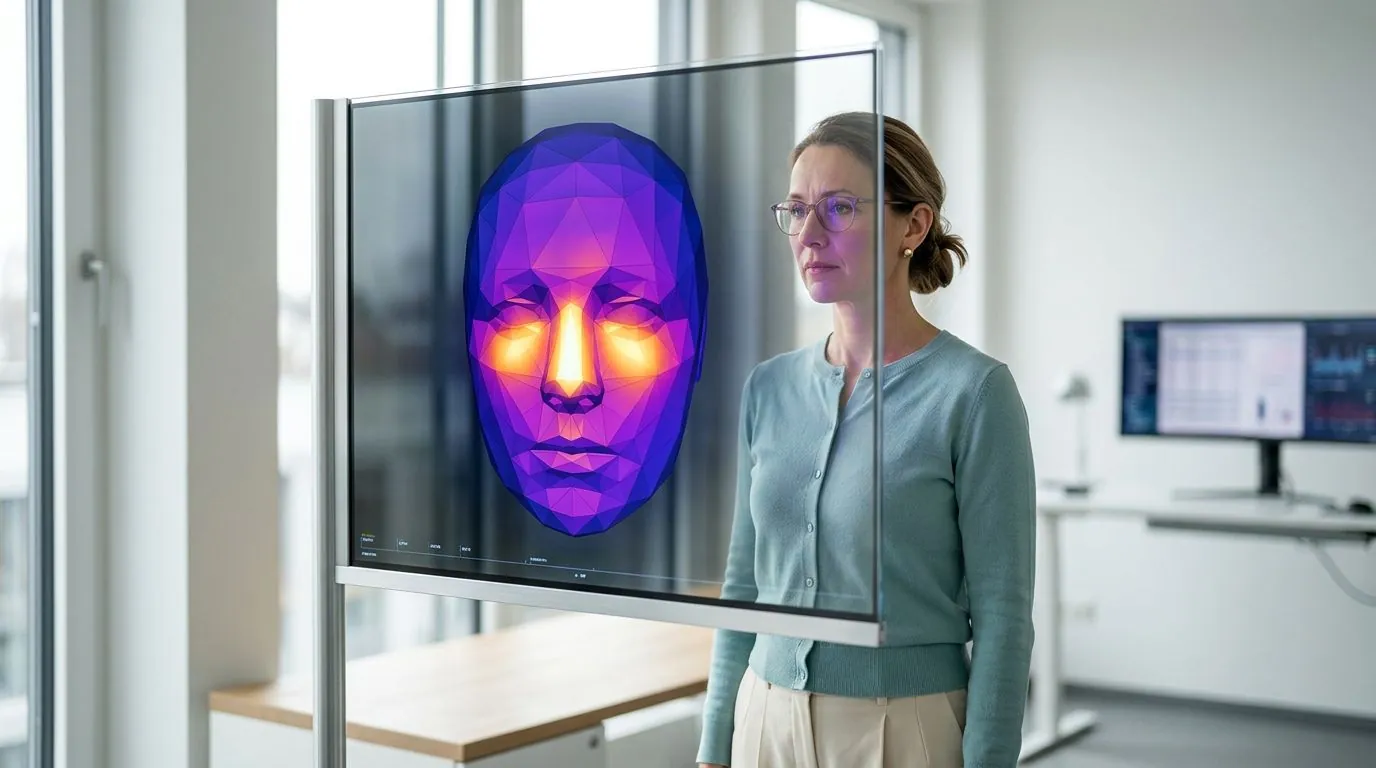
Researchers at Mass General Brigham published a study in The Lancet Digital Health on October 19, 2026, describing FAHR-Face, an AI model trained on more than 40 million face photos. It estimates a patient’s biological age and directly predicts survival after a cancer diagnosis. Patients whom the model judged to look at least 5 years older than their chronological age had a 21% higher risk of death. Patients in the highest-risk group of a second tool, FAHR-FaceSurvival, died more than three times as often as those in the lowest.
- Mass General Brigham researchers published a study in The Lancet Digital Health on October 19, 2026, describing FAHR-Face, a foundation model trained on more than 40 million face photos from the WebFace42M dataset that was used to build FAHR-FaceAge, which estimates biological age, and FAHR-FaceSurvival, which predicts cancer survival directly from a face photo.
- In a cohort of 38,211 cancer patients, looking at least 5 years older than chronological age was linked to a 21% higher risk of death (adjusted HR 1.21), while patients in the highest quartile of the FAHR-FaceSurvival score had more than three times the mortality of those in the lowest (adjusted HR 3.22).
- In an independent validation cohort of 4,892 patients from the Maastro clinic in Maastricht, both FAHR-FaceAge deviation and FAHR-FaceSurvival remained significant predictors of survival, but the authors note the Harvard cohort was 87.6% white and the tools are not approved for clinical use anywhere.
One foundation model produces two tools
The team at Mass General Brigham, a Boston network of academic hospitals affiliated with Harvard Medical School, built FAHR-Face (Foundation Artificial Intelligence for Health Recognition) as a foundation model. That is a general representation of faces that can later be fine-tuned for specific medical tasks. The model was trained with self-supervised learning on more than 40 million unlabeled face photos from the WebFace42M dataset. Two separate tools were derived from it:
- FAHR-FaceAge estimates biological age, meaning how old someone looks rather than how old their records say they are. It was fine-tuned in two stages on 749,935 public photos labeled with age.
- FAHR-FaceSurvival does not go through age. It learns the risk of death directly from a photograph. It was fine-tuned on 34,389 photos of cancer patients from the Harvard RT cohort, patients treated with radiotherapy at Harvard-affiliated centers from 2008 to 2023.
Both tools share a core but analyze different areas of the face. FAHR-FaceAge focuses on the nasolabial folds, the forehead just above the eye sockets and the temples. FAHR-FaceSurvival looks at the area under the eyes and around the bridge of the nose. The authors checked this with the model’s attention maps. The correlation between the two tools’ outputs was also low (R of 0.16 to 0.22, depending on the cohort), so each picks up a different health signal.
Hugo Aerts, director of the Artificial Intelligence in Medicine (AIM) program at Mass General Brigham and a co-author of the study, said: “To our knowledge, this is the first demonstration that an AI model can directly predict cancer survival.”
Looking 5 years older meant a 21% higher risk of death
The central result concerns the gap between the age the AI estimates and chronological age. The authors call it FAD (FAHR-FaceAge deviation). In a cohort of 38,211 cancer patients, the median FAD was 1.1 years. Some 33% of patients looked at least 5 years older than their records indicated, 17.1% looked at least 10 years older, and 24.3% looked at least 5 years younger.
The authors adjusted for age, sex, origin, tumor site, treatment intent, year of treatment and radiotherapy technique. After that, a FAD of at least 5 years was linked to a 21% higher risk of death (adjusted hazard ratio, HR, of 1.21). A FAD of minus 5 years or lower was linked to a 17% lower risk (HR 0.83). These come from a multivariable analysis, so the effect of appearance is not simply that older people die more often.
The second tool produced a sharper split. Patients in the highest quartile of the FAHR-FaceSurvival score had more than three times the mortality of those in the lowest (adjusted HR 3.22). More than 50% of patients in the highest decile died within 90 days, compared with 2% in the lowest decile. The overall C-index, a measure of how well a model ranks patients by risk, was 0.72. Across subgroups it ranged from 0.53 to 0.88.
Age estimation itself also improved over earlier algorithms. On the public APPA-REAL dataset, FAHR-FaceAge reached a mean absolute error of 5.1 years. The same transformer trained from scratch reached 6.92 years. The predecessor, a model called FaceAge described by the same team in May 2025, scored an error of 12.6 years on that dataset because it was trained mainly on people over 60.
| FAHR-FaceAge | FAHR-FaceSurvival | |
|---|---|---|
| What it predicts | biological age in years | mortality risk score from 0 to 1 |
| Fine-tuning data | 749,935 public photos | 34,389 photos of cancer patients |
| Facial area | nasolabial folds, forehead, temples | area under the eyes, bridge of the nose |
| Main result | FAD ≥ 5 years: HR 1.21 | highest vs. lowest quartile: HR 3.22 |

Validation on 4,892 patients in the Netherlands confirmed both signals
Both models were tested on an independent cohort from the Maastro radiotherapy clinic in Maastricht. It included 4,892 patients with a median age of 66, of whom 47.2% were women. The most common diagnoses were breast cancer and cancers of the gastrointestinal tract, the genitourinary system and the lung. Median follow-up was 3 years.
In this group FAD remained a significant predictor of survival (adjusted HR 1.127 per decade), as did FAHR-FaceSurvival (HR 1.086 per 0.1 points). A model combining both indicators fit better (AIC of 26,560) than either alone. That suggests two tools built on one foundation model do contribute complementary information.
Analysis
The numbers are impressive, but what I find most interesting in this study is something else. The team showed that one large face foundation model can be fine-tuned more cheaply and quickly for successive clinical tasks, without training everything from scratch. It is the same logic that drives language models, applied to a patient’s photograph.
And that is where the problem starts. FAHR-FaceSurvival’s attention map concentrates on the area under the eyes and around the nose. Physicians have for centuries linked that region to the so-called Hippocratic face in the dying. In other words, the algorithm has largely automated the “eyeball test” that an experienced oncologist performs in the first seconds of a visit.
Is that bad? Not necessarily, because the numerical version is repeatable and can be audited. But inside a hospital system such a result becomes a hard number next to blood work. Numbers make it easier to justify a decision to step back from aggressive treatment than intuition does. The question I would want answered is who will be accountable when the model mistakes fatigue after chemotherapy for frailty.
Smoking and alcohol age a face in the AI’s eyes; makeup and plastic surgery barely do
The authors tested what the model actually reads from a face. Heavy alcohol use, drug use and smoking were linked to a higher biological age. Smoking had the strongest and most orderly effect: current smokers looked older than former smokers, and former smokers looked older than people who had never smoked. The dose relationship with pack-years appeared in both tobacco-related cancers and the rest.
Robustness to manipulation was tested on paired photos of the same people. Corrections of the brows and eyelids, facelifts and facial bone corrections did not significantly change the estimated age. Only nose correction raised it, by 1.11 years on average. Makeup, camera angle, lighting and facial expression also produced no statistically significant differences. Raymond Mak, a radiation oncologist at the Mass General Brigham Cancer Institute and the study’s corresponding author, called this stability a surprising result.
Mak also set limits on the tool’s role. He said the goal is to make health assessment from a face photo more quantitative, consistent and scalable, so that it will “support personalized treatment decisions rather than replace physician judgment.”
Limitations: cohorts are mostly white, Western and cancer-only
The authors list several weaknesses themselves. In the test portion of the Harvard cohort, 87.6% of patients were white, 4.9% were Black and 3.1% were Asian. For Hispanic patients, the association between FAHR-FaceSurvival and survival did not reach statistical significance. The study covers only cancer patients from Western centers, which may limit how well the results transfer to other diseases, regions and underrepresented groups. Photo quality still affects accuracy, and regulatory, organizational and reimbursement barriers remain before routine use.
Privacy is another issue, since the tool by definition operates on identifiable images of patients. Mass General Brigham has filed a provisional U.S. patent application for next-generation algorithms that recognize health from faces. The study was funded by the European Research Council (ERC). The authors say the code and weights of the foundation model and of FAHR-FaceAge will be released on GitHub after publication.
Outside criticism surfaced with the previous version of the tool. In May 2025, when the same team published its first FaceAge study, Jennifer Miller, co-director of the biomedical ethics program at Yale University, told The New York Times: “I’d be very worried about whether this tool works equally well for all populations.”
The new study answers that objection only in part. It adds external validation and subgroup analyses, but the racial makeup of the cohorts remains heavily skewed.
The tools are research-only, but the public can join a study
FAHR-FaceAge and FAHR-FaceSurvival are not approved for clinical use anywhere and remain at the research stage. The Mass General Brigham team does run a publicly open online FaceAge Research Study, approved by an ethics board. Participants can upload a face photo and receive their own research result, and the photo also feeds the data used to validate the model in larger and more diverse populations. It is the only legal way for someone outside the U.S. to come into contact with the technology today.
A separate check concerns data protection. Analyzing a patient’s face for health status involves biometric data and health data, both specially protected categories under the EU’s GDPR. Deploying such a tool in a hospital covered by the GDPR would require a separate legal basis and a data protection impact assessment, whatever further clinical validation shows. That is an editorial assessment, not a conclusion of the study’s authors.
Sources and methodology
- Haugg F. et al., “Foundation Artificial Intelligence Models for Health Recognition Using Face Photographs (FAHR-Face): a model development and validation study,” The Lancet Digital Health, October 19, 2026 (full-text preprint: arXiv).
- Press release, Mass General Brigham, October 19, 2026.
- The Guardian, October 20, 2026.
- Becker’s Hospital Review, Medical Xpress and Harvard Gazette were also used for verification.
The quotes from Hugo Aerts and Raymond Mak were verified against the original English-language Mass General Brigham press release. The quote from Jennifer Miller of Yale comes from her May 2025 statement to The New York Times, cited secondhand by Futurism, and concerns the earlier version of the tool, FaceAge.
Analysis and editorial responsibility: Piotr Wolniewicz, Editor-in-Chief, AIPORT. Original Polish reporting: Natalia Kaszubowska (aiport.pl).
This article was originally published in Polish on aiport.pl on October 20, 2026. https://aiport.pl/co-nowego-w-ai/fahr-face-ai-z-mass-general-brigham-przewiduje-szanse-przezycia-chorych-na-raka-z-jednego-zdjecia-twarzy/