

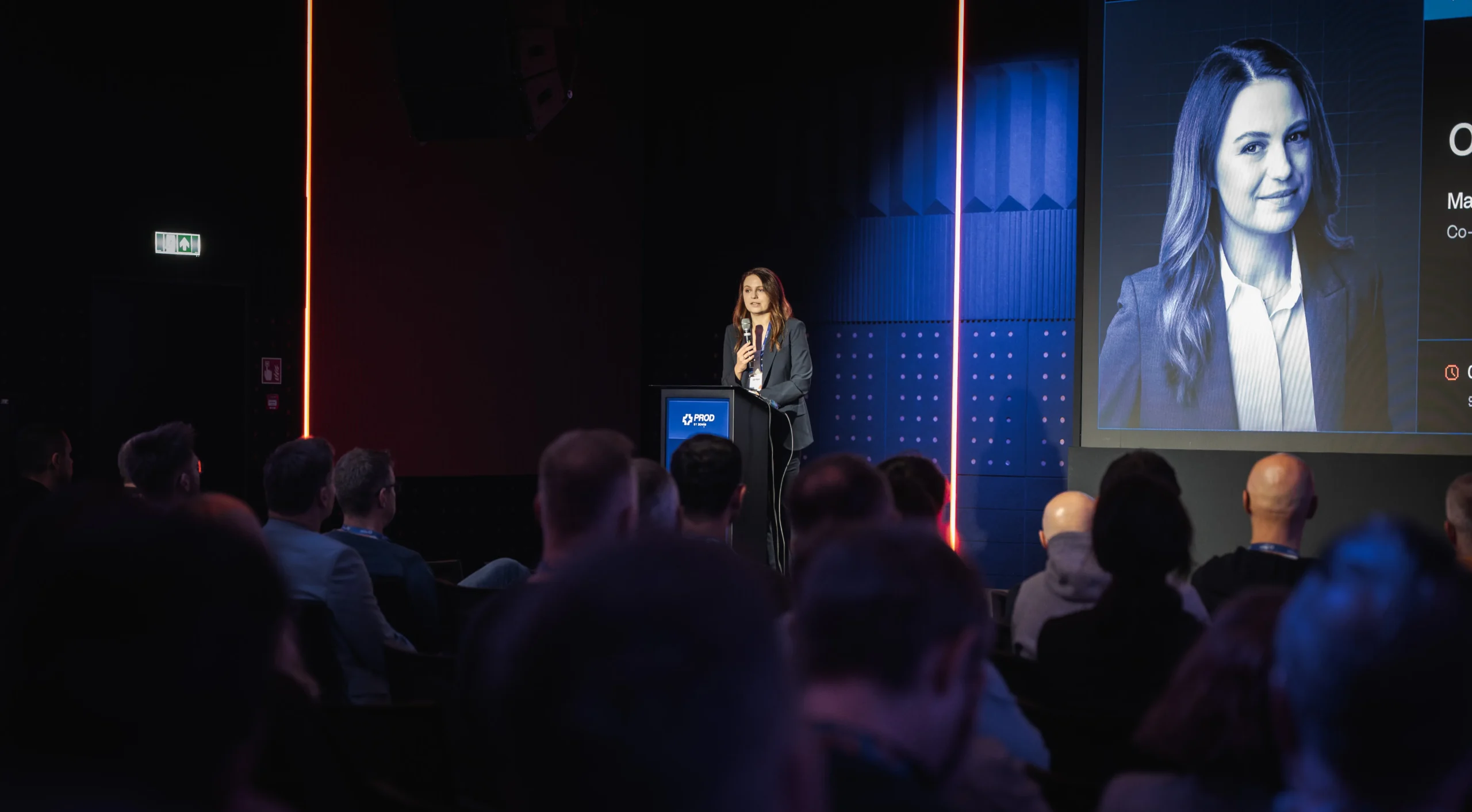
More than 170 technology executives, CTOs and systems architects met on October 13, 2026, at PROD 2026, a closed conference at Fabryka Norblina in Warsaw, to compare early lessons from large-scale AI deployments in production. The main conclusion: companies are ceasing to measure AI success by the number of licenses bought and are starting to judge it by time actually saved, how much the tools are used and the operational edge they provide.
- At PROD 2026, an invitation-only conference held on October 13, 2026, at Fabryka Norblina in Warsaw and organized by Zowie, more than 170 technology executives, CTOs and architects concluded that companies are starting to judge AI by time saved, level of use and operational advantage rather than by the number of licenses bought.
- Speakers including Marcin Bednarski of VeloBank argued that simple chatbots are finished and that mature deployments need agent orchestration with defined data, permissions and a handoff point to a human.
- Zowie's post-conference summary said effective AI deployment requires cleaning up processes first, with consistent data identifiers and modern APIs, and that engineers' work is shifting from writing code to designing architecture, refining specifications and verifying results.
The organizer was Zowie, a Polish company that builds a platform of AI agents for customer service. The conference had no open registration or ticket sales and was invitation-only. Panelists came from Orlen, InPost, LPP, VeloBank, Bank Pekao, Bank Millennium, Orange Polska, LUX MED, McKinsey & Company, PwC, EY and CLICO. The program ran in two tracks. One covered new AI products, application security and contact centers. The other covered AI testing, in-house tools and working with agents to build software.
Simple chatbots are finished; the market is moving to agent orchestration
The strongest message was that simple chatbots are a closed chapter. Mature deployments, speakers argued, need orchestration of agents with clearly defined data, permissions and a point at which a case passes to a human.
Marcin Bednarski, AI adviser to the CEO of VeloBank, said that companies need orchestration instead of a magic bot. Before an agent starts, he said, someone has to answer four questions: who triggers the task, where the agent gets its data and permissions, when it hands the case to a human, and who sees an error and restarts the process. Without those answers, he said, the agent has talent but no on-call duty.
A second recurring theme was order before automation. Participants agreed that automating chaotic procedures only raises costs. The foundation of a deployment, they said, is a unified IT environment, consistent data identifiers and open access to application programming interfaces (APIs).
Anna Potocka, Head of AI at LUX MED, a large medical organization, described what this looks like in practice. She said that processes slated for automation sometimes contain too many exceptions. Teams have to work on those exceptions and keep the process closer to a standard so that automating it makes sense. Often, she said, they also have to remodel the sources an agent draws on so the AI can understand them and answer adequately.

Engineers are shifting from writing code to writing specifications
On software engineering, speakers described a move from traditional programming to specification-driven design. Specialists define in detail how systems should behave and what quality criteria they must meet. AI agents produce first-draft code, documentation and routine tests. Humans focus on architecture, verifying results and making decisions.
Maja Schaefer, co-founder and CEO of Zowie, said that the market is learning extremely fast in advanced AI use cases. Companies that test new hypotheses efficiently and learn from practice are the ones gaining, she said. In her view, success in production depends less on writing code and more on defining quality criteria precisely and collaborating across disciplines.
Customer service is changing the same way. Dawid Telepski, Contact Center Director at LPP, a Polish fashion retailer, contrasted yesterday with today. Previously, he said, an agent looked up customer and order data, checked the store and the shipment status, wrote an email and waited for a reply. Now, he said, an AI agent has the full context of a case from the start of the contact. It verifies the shipment, contacts the store, tracks deadlines set by service-level agreements (SLAs) and monitors status changes.
Karol Tajduś, Chief AI Officer at Bank Pekao, a major Polish bank, added an architectural condition that carries particular weight in banking. He said technology and architecture decisions should preserve flexibility. A bank cannot become dependent on a single vendor, he said, and if that vendor stopped providing services tomorrow, it must be able to replace it with another.
Analysis
My main takeaway from this conference matters more than the rest. Large Polish companies have stopped treating AI as an innovation-department project. They now treat it like any other production technology, with a process owner, SLAs and accountability measured in time. That is good news, because it means the end of buying licenses “just in case” that then sit unused.
I also see a catch. Every person quoted talks about cleaning up processes, unifying data and building APIs. That is work that should have been done long ago, with or without AI. AI works here like a mirror: it shows how much process debt an organization carries. The companies on the speaker list have the budgets to pay that debt down. The question is what happens to the rest of the market, for whom “first tidy up your processes, then automate” may sound like advice they cannot afford.
One more point. Pekao’s declaration of independence from a single vendor was made at a conference organized by a vendor. I don’t mean that as an accusation. I read it as a signal that enterprise customers are negotiating from a firmer position than they were two years ago.
Zowie’s four takeaways put process cleanup ahead of tools
In its post-conference material, Zowie condensed participants’ main findings into four points:
- Effective AI deployment requires first cleaning up processes and having consistent data identifiers and modern APIs.
- The biggest technological benefit comes from integrating systems around consistent communication protocols, which reduces the complexity of enterprise architecture.
- The engineer’s role is evolving: teams’ attention is shifting from repetitive code writing to designing architecture, refining specifications and verifying results.
- Scaling AI in large organizations requires clearly defined process owners, constant quality monitoring and secure architectures that limit the risk of error.
The organizer also pointed to a clearly growing trend: AI agents in cybersecurity, used to continuously scan IT systems and automatically fix vulnerabilities in real time.
Organizer Zowie says it handles more than 100 million conversations a year
Zowie was founded in 2019 by Maja Schaefer and Maciej Ciołek. By its own figures, it handles more than 100 million conversations a year for clients such as InPost, Decathlon and MediaMarkt.
In early October 2026, InPost, the Polish parcel-locker operator, announced the rollout of an AI agent built with Zowie. During a phone call, the agent can reroute a parcel, change the delivery date, resend a pickup code and remotely open a compartment in a Paczkomat, InPost’s parcel locker. The system runs in Poland, the United Kingdom and France.
What to check before trying this
The conference was closed, but its conclusions translate into questions any organization can ask before buying AI tools:
- Does the process we want to automate have a defined standard, or does it consist mostly of exceptions?
- Who owns the process, and who will see an agent’s error and restart the work?
- Where will the agent get its data and permissions, and when will it hand a case to a human?
- How will we measure the effect: by the number of licenses, or by time saved and level of use?
- Will the architecture let us replace a vendor if it stops providing services tomorrow?
Judging by the statements at PROD, the answers to these questions separate deployments that save time from those that only raise costs.
Sources and methodology
The article is based on a press release from Zowie about PROD 2026 (October 13, 2026, Fabryka Norblina, Warsaw), sent to AIPORT’s newsroom on October 20, 2026, and on the PROD Conference 2026 event page.
- Zowie, PROD Conference 2026 event page: https://prodconf.getzowie.com/pl
Statements attributed to Maja Schaefer (Zowie), Anna Potocka (LUX MED), Dawid Telepski (LPP), Karol Tajduś (Bank Pekao) and Marcin Bednarski (VeloBank) come from the organizer’s press material, where they appear in Polish. They are paraphrased here, not quoted. The InPost deployment details come from the same material and from the company’s early October 2026 announcement.
Analysis and editorial responsibility: Piotr Wolniewicz, Editor-in-Chief, AIPORT. Original Polish reporting: Piotr Wolniewicz (aiport.pl).
This article was originally published in Polish on aiport.pl on October 20, 2026.
https://aiport.pl/co-nowego-w-ai/prod-2026-ponad-170-cto-i-architektow-rozlicza-ai-z-czasu-a-nie-z-liczby-licencji/